Tuesday, 19 February 2013

The Dome


Our ultimate plan was to get everything working in The Dome at the university, as it would enhance the over all experience of the user, and since the dome encompasses all the sense around you this will magnify was what is going on during the experiment. 
But the Dome takes a lot of correcting, so the video would have to changed into a fish eye lens, greater resolution and definition then what we have with our videos, and due to time constraints we decided against this as we should focus on getting everything else perfect before we do a massive change to the project. 


These have been previous university experiments that have been introduced into the dome from i-Dat. The Dome works with various programs, such as 
  • Game Engines (Blender and Unity 3D)
  • Processing sketches
  • Quatrz Composer
  • Pure Data
  • Video (fisheye correction)
  • RSS feeds


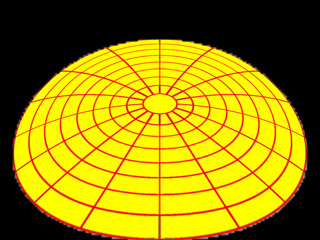
'As with most dome image creation, one either renders a cubic environment (perspective projection to 5 sides of a cube) and then resamples onto an angular fisheye image, or if the rendering software supports it the fisheye image is rendered directly. The model used to create the image above is simply a sphere made up from a grid of lines of longitude (every 30 degrees) and latitude (every 20 degrees). The cubic texture and spherical map are shown below, the distorted image above can be derived from either of these two representations. This is the obvious candidate for a test pattern because one knows the pole should be in the top/center of the dome and the lines of longitude and latitude should be straight, assuming the observer is located in the center of the hemisphere.'- Taken from Paul Bourke.


Unfortunately we don't have the time nor the resources to correct our project to the dome. Which is sad, because it would be awesome to see our work in 4D. 

Monday, 18 February 2013

Thoughts and Musings


Okay so I've been looking a load of tutorials for 3-D animation and rendering, it all seems really interesting and fun. Really glad I said I'll do the animation, really enjoying it. We have been having trouble as a group in what we want our project to say about 'us'. We have decided to call our project 'ShockFlow'. I like it, it's quite eloquent, a combination of horror and calm within the name, which is what our project is about.

This is a still of the final product of the blood cells flowing around the veins. As a group we thought it would have more significance if the output was blood flow, and it would symbolise more than just a heart beat, as you can see the actual speed and current of your blood stream. I saw it as blood flow controls everything in your body so why shouldn't you be able to see how your body is reacting to our experiment. 
I have only uploaded a still because to upload the full video would take a while just to upload a 20 second clip.


Thursday, 14 February 2013

Coding


We have found an open source program that allows us to connect up our pulse sensor and this program will use minim to output a frequency. 


 if (second() < 59){
    if(f > 9){
       heartbeat++;
    } 
  }else{
    println("number of heartbeats that happened this minute: " + heartbeat);
    heartbeat = 0; 
  }
  println(heartbeat); 

Me and Iain wrote this in so processing will look at the computers clock, and every 59 seconds the program will take down an accurate heart rate.


Tuesday, 12 February 2013

3D animation and how the heart works


So here is my main portion of the project that is 3-D animation, my group have been talking a lot about the animation and what it is to represent, we talked about the camera following the blood cells around the veins, but I want to do something simple so the user is not distracted on what is going on off screen (if we do go with the two screen ideas). We want the user to be fully immersed on the scary/calm videos. I would like to create an animation and 3-D model that it just shows the heart and each of its chambers beating, representing the users own heart beat. Below is an example of what I want to achieve. 


Below is a still of an example I have been working on for a while, it is just the outer shell representation of the heart. Definitely not what my team was expecting me to do so I thought I would use that as a reference, or a fall back if things don't work out.


The heart has 4 chambers, the left and right atrium, and the right and the left ventricle. The two ventricles pump oxygenated blood towards the body, and the atrium's pull de-oxygenated blood towards the heart so it can be re-oxygenated. And the four heart valves (tricuspid, pulmonic, mitral and aortic) keep the blood moving in the right direction through the heart.

Heart chambers

Below is an animation done by Natalie, which represents how I want to animate my heart model. Each chamber beating in turn like the real beating heart does.


PULSE RATES-'Taken from How Stuff works'

Everyone's pulse (average heart rate per minute) changes as we age. Here is a list of average pulse rates at different ages:
  • Newborn: 130 bpm
  • 3 months: 140 bpm
  • 6 months: 130 bpm
  • 1 year: 120 bpm
  • 2 years: 115 bpm
  • 3 years: 100 bpm
  • 4 years: 100 bpm
  • 6 years: 100 bpm
  • 8 years: 90 bpm
  • 12 years: 85 bpm
  • adult: 60 - 100 bpm


Saturday, 9 February 2013

Possibilities


In this experiment you can learn a whole lot about yourself. Depending on your ability to handle shocking material, after finished the initial test, you will learn a lot about your cardiovascular system-

  • Heart rate
  • Physical fitness (which is tied into your cardiovascular) 
  • Maximum cardiac rate
  • Minimum cardiac rate 
  • Recovery rate
  • Blood pressure 
'The circulatory system is responsible for the internal transport of many vital substances in humans, including oxygen, carbon dioxide, and nutrients. The components of the circulatory system include the heart, blood vessels, and blood. Heartbeats result from electrical stimulation of the heart cells.'

Taken from Vernier

This experiment opens up a world of answers to you using some very useful equipment and programming. 

Thursday, 7 February 2013

Basics of the Project


We want to use the dome area to show off our project so the user can get the full experience in 4-D. We are going to super impose the video that controls the emotions onto the animation of blood cells flowing around the body, I think this will be an excellent effect as you can see what is going on in your body at the same time as your emotions being shown on the screen. 

This will be a scientific experiment as well to show how desensitised as a society we are, so even though the scary videos are popping up, the user might not be scared or shocked. But we can't determine how desensitised we all are with only one test subject, so there would have to be multiple test subjects, or different gender, race, age and ethnicity. So we could also determine what type of people has the least sensitivity when it comes to shocking material.

What will be attached to you


On one end you have a very sensitive piezo sensor which will be attached just below your heart, where it will be able to pick up your heart beat better. And on the other side you have a standard jack cable which will be plugged into a microphone port on your laptop or PC. This will transfer the sound of your heart through the laptop to the program me and Iain have modified that will change the animation due to your heartbeat as well as playing the sound of your heart through minim. 

Equipment -

  • A piezo pickup
  • A mic cable
  • A jack cable
  • A piece of foam (so it doesn't vibrate)


This is an example of where the pickup will sit on  your chest so it can pick up the heart beat. Natalie is using various clips from Youtube to provoke calmness, happiness, fear, shock and horror. Look to her blog for her part of the project. 

As I mentioned earlier we are going to see this as an experiment more than just a project, as we have no idea how people will react to this and we won't know the results until the end. This might be a success for one user, but a failure for another user. We will have to wait and see in the final experiment.